
Introduction#
Urban parking is broken—and most cities already know it.
Drivers waste time searching for spots, operators struggle with enforcement, and cash-based systems continue to leak revenue. As vehicle density increases in cities like Bengaluru, Delhi, and Mumbai, the limitations of traditional parking systems are becoming impossible to ignore.
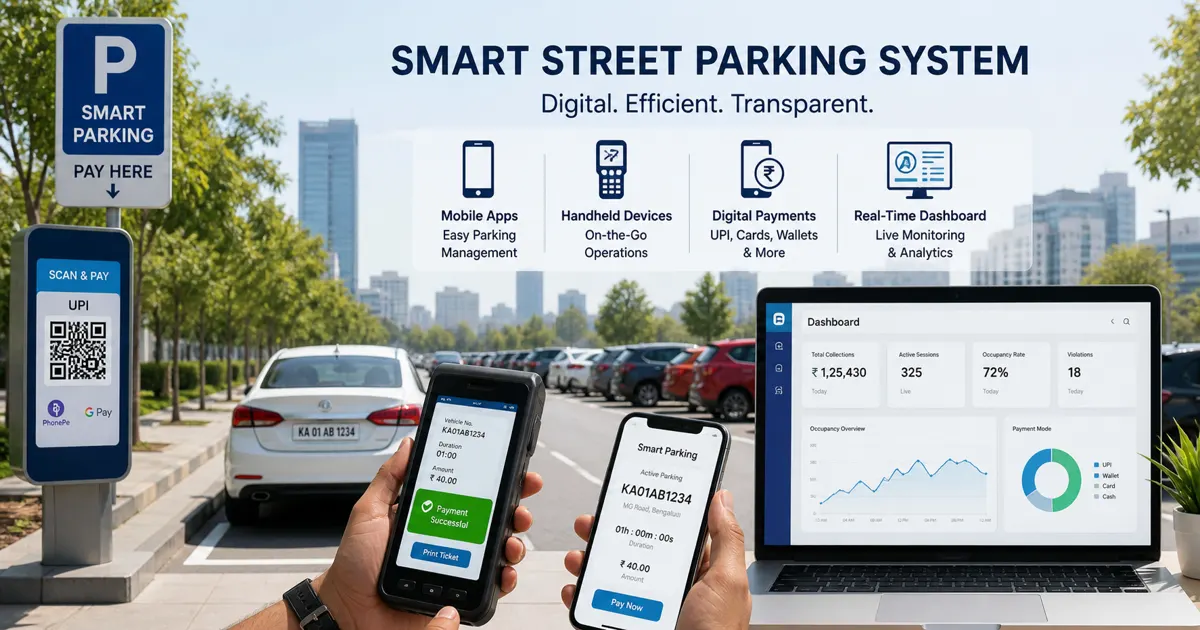
A smart street parking system solves this by combining mobile apps, handheld devices, digital payments, and real-time dashboards into a single connected platform.
This isn’t just digitization—it’s operational control.
What Is a Smart Street Parking System?#
A smart street parking system is a digitally integrated solution that manages the entire parking lifecycle:
- Parking discovery
- Session tracking
- Payment processing
- Enforcement
- Analytics and reporting
Instead of manual processes, everything is tracked and updated in real time.
Why Traditional Parking Systems Fail#
Most legacy systems rely on:
- Paper tickets
- Cash collection
- Manual tracking
- Limited enforcement
Key Problems#
- Revenue leakage due to untracked cash
- Traffic congestion from inefficient parking
- No real-time visibility for operators
- Poor user experience
Without data, optimization is impossible.
Key Components of a Smart Parking System#
1. Mobile Apps for Users and Administrators#
Mobile apps improve accessibility and reduce friction—but they should not be the only entry point.
For users:
- Find nearby parking spaces
- Start/stop parking sessions
- Get expiry alerts
- Pay instantly via UPI
- Smart RFID cards
- Wallet
For operators:
- Monitor occupancy in real time
- Track violations
- Access reports and analytics
2. Handheld Devices for On-Ground Operations#
In real-world deployments, especially across India, handheld devices are critical.
They allow parking attendants to:
- Record vehicle entries
- Generate digital or printed tickets
- Display QR codes for payments
- Operate offline and sync later
Why this matters:
- Not all users install apps
- Faster rollout without heavy infrastructure
- Works in high-density street environments
3. Digital Payments (UPI, QR, Cards)#
Cashless payments are the backbone of transparency.
Supported methods:
- UPI (dominant in India)
- QR code payments
- Debit/Credit cards
- Mobile wallets
Platforms like PhonePe and Google Pay reduce friction and improve adoption.
Benefits:
- Eliminates cash handling risks
- Creates a complete audit trail
- Faster transactions
- Reduces revenue leakage
4. Real-Time Dashboard & Analytics#
A centralized dashboard gives operators full system visibility.
Core features:
- Live parking occupancy
- Active sessions tracking
- Real-time revenue monitoring
- Violation alerts
Advanced insights:
- Peak demand analysis
- Location performance tracking
- Staff productivity
- Dynamic pricing recommendations
This is where parking becomes a data-driven system.
Benefits of Smart Street Parking Systems#
For Cities and Authorities#
- Reduced traffic congestion
- Improved compliance and enforcement
- Better urban planning through data
For Operators#
- Increased revenue collection
- Lower leakage
- Real-time operational control
For Users#
- Faster parking discovery
- Seamless payment experience
- Reduced uncertainty
Real-World Adoption in India#
Cities like Bengaluru, Delhi, and Mumbai are actively implementing smart parking initiatives to address congestion and improve efficiency.
As urban density increases, these systems are shifting from optional upgrades to essential infrastructure.
Why Organizations Should Adopt Smart Parking Now#
If you manage:
- Smart city infrastructure
- Hospitals or campuses
- Commercial complexes
A smart parking system delivers:
- Transparent revenue tracking
- Better compliance
- Improved user experience
- Data-driven decision-making
Conclusion#
A smart street parking system is not just about convenience—it’s about control.
It replaces fragmented, manual processes with a connected system that improves visibility, reduces leakage, and enhances user experience.
In growing urban environments, this shift is no longer optional—it’s inevitable.
Looking to Implement a Smart Parking System?#
Organizations can use smart street parking systems to bring parking discovery, handheld operations, digital payments, enforcement, and real-time reporting into one connected platform.
If you manage smart city infrastructure, hospitals, campuses, or commercial complexes, reach out to explore how a smart parking solution can improve revenue visibility, reduce manual work, and create a smoother parking experience for users.